Monday, September 28, 2015

Literary Web series: part 1


I've really enjoyed following several literary web series and wanted to review a few of the ones I've followed. These are classic books that have been adapted to a youtube style video diary. They also usually involve other forms of social media eg. the characters have twitter accounts.

You can find a list of most of the Literary web-series in existence here. I am going review ones that I have watched all the way through (or up to the latest episode) and have enjoyed.

The first one that I watched (and the one that started this genre) was the Lizzie Bennet diaries based on Pride and Prejudice. I think it worked especially well because in the book, though it's not in first person, the reader sees everyone from Elisabeth's somewhat biased perspective and slowly see things more clearly as the book goes on. Since the video diaries are from Lizzie's perspective they have the same effect. This series was also very clean apart from a few references and one plot element. As far as I remember everything shown on screen was totally appropriate. Lizzie Bennet Diaries was made by Pemberly Digital. They have also made Emma Approved (which I liked), Frankinstien MD (didn't like the original book so...), and the March Family letters (released by PD but made by a different company and I definitely did not like as much).

The next series I really got into was The Autobiography of Jane Eyre, based, surprisingly enough off Jane Erye. This was a low-no budget production but they did a fantastic job bringing Jane Eyre into the modern day. I loved the actor who played Jane she had a sweetness and sincerity about her that was very true to the book. I cried during the episode where Jane finds out the truth about Rochester and Bertha. The ending was a little disappointing because the actor who played Rochester wouldn't come back for some reason and so I didn't feel like the huge emotions from the first half were ever really wrapped up. This series was also very clean in general. Some of the extra videos were not, though.


Jules and Monty is an adaption by Tufts students of  Romeo and Juliet with the warring houses re imagined as rival frats at a college. For me it really captured the beauty of young love as well as the tragedy of the ending. The way they put Shakespearean language in was sometimes awkward and there were some glaring plot holes near the end. There are a lot of frat parties and references to sex and drinking, including the scene after Romeo and Juliet have consummated their marriage, though in this version they aren't married.


Hope you enjoy some of these! I'll be posting more of these eventually.

Saturday, September 26, 2015

Flavors of the Week 1

What I've been reading:


Poem I've been liking:

No speed of wind or water rushing by
But you have speed far greater. You can climb
Back up a stream of radiance to the sky, 
And back through history up the stream of time. 
And you were given this swiftness, not for haste 
Nor chiefly that you may go where you will, 
But in the rush of everything to waste, 
That you may have the power of standing still- 
Off any still or moving thing you say. 
Two such as you with such a master speed 
Cannot be parted nor be swept away 
From one another once you are agreed 
That life is only life forevermore 
Together wing to wing and oar to oar 


Robert Frost for his daughter on her wedding


What I've been listening to:


Henry IV part 2

Part 2 picks up where part 1 left off. Henry IV is declining quickly and everyone is wondering if Hal has what it takes to be king. Hal still occasionally participates in the dark dealings of London's underbelly and his father is far from sure that he is ready to be king. Meanwhile another plot is brewing to overthrow Henry.

Hal is all along planning to throw off his low companions. As the ministers of state assure Henry IV, his son is studying the lower classes as one would study a language. In my post about part one I mentioned some of the ethical problems I had with what he was doing and why he was doing it. But in this play it struck me as so lonely. Hal does appear to care about both his father and his brothers, but up until his father is within inches of death he spends very little time with them. Instead he builds relationships with people he is planning to abandon.

It was interesting to see the interplay between Hal and Poins. Poins clearly thinks that he is the one true friend Hal has while Hal considers him another person to throw off. I am not sure how you live like that, never really getting close to anyone you spend your time with, never really trusting, always knowing you will leave them in the end. However Kings have to spend a lot of their time with people they do not love or trust and must always put their people above any personal feelings and I don't think I could do that either.


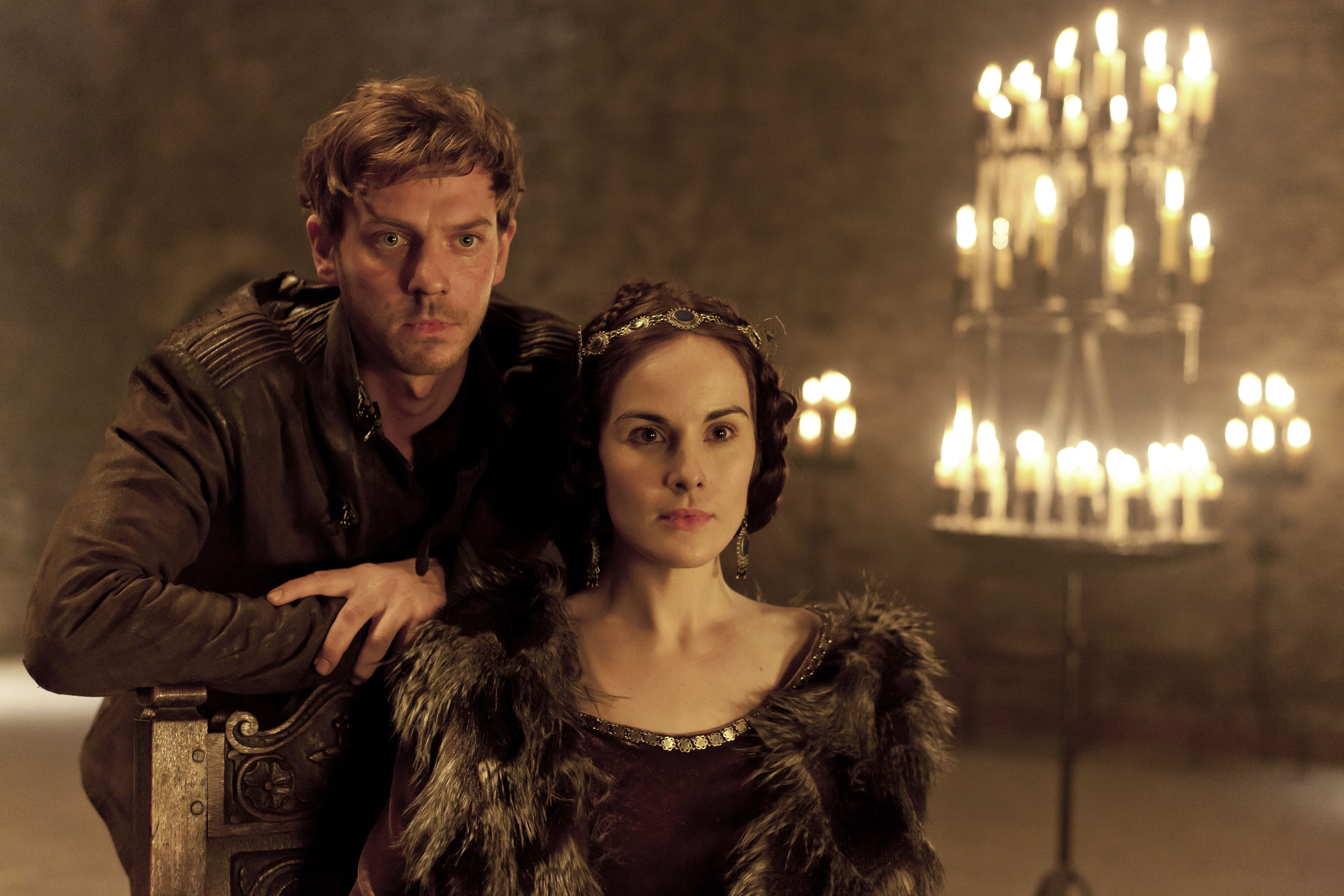
I was glad we got to see Lady Percy again even if briefly. Part 1 never shows her at all after her husband's death and I didn't feel like we had closure with here character. She seemed to get along quite well with her in-laws. I was also a big fan of her dress as seen on right

 The part of this play that struck me most deeply was Prince John's treatment of the rebels. It seemed crazy to me that he would break his word like that. It just seemed so completely dishonorable to , have them call off their troops in a show of good faith and then slaughter their men. The only person who seems to question the affair was Falstaff. And when Falstaff is the best moral compass in thee play I think we are in serious trouble. Of course little googling showed that Prince John was the one who executed Joan of Arc so...

Overall I found part two less interesting than part one but definitely well worth watching.


Photos from alwaysiambic.tumblr.com and telegraph.co.uk

Friday, September 25, 2015

Portals of Morian

It was late, later than it should have been. Soon the campus would contain only be me and an handful of others unfortunate enough to have homes too far away for it to be worth the trip. I already knew my time in the abandoned dorm would be spent on the many projects and assignments which had been generously heaped upon me by a myriad of PHD laden members of the society against free time. I was engaged in planning the layout of what was to be a credit to the race of amateurly designed micro processors. My partner in this joy-filled exercise was twirling his short brown hair with a pencil, his blue-green eyes not quite focused on the multiplexer he should have been drawing.

That night we talked well into the night. He told me about "the best friend he had ever had" and a youth pastor who had almost turned him away from the church. I don't even remember what I told him.  Hearing the word best friend from him hurt me in a way I hadn't imaged it would. I had grown to feel so close to him in the last few months that the thought of some one closer sent a short silent stab through me. Somewhere around two AM he offered to take me to Walmart and I agreed to go.

It shouldn't have meant anything. Nothing. Midnight visits to the lofty super store was a ritual which inmates of colleges everywhere practiced religiously in groups of all sizes. But somehow I felt more than knew that something between us had shifted. An invisible balance had swiftly and silently tilted.

Sunday, September 13, 2015

Henry IV part 1

I really enjoyed watching Henry IV part 1. King Henry IV who took the throne from Richard in Richard II is still king. His son, also named Henry but known as Hal, is a constant source of vexation for his father. He spends most of his time and most of the play in various public houses, carousing with various commoners. On the other hand Percy, known as Hotspur, the son of Northumberland is winning battles left and right and generally doing everything Henry wishes Hal would do. Hotspur, however, has a temper and it explodes when king Henry demands him to turn over some prisoners he has taken. He, together with his brother-in-law, who some see as Richard's rightful heir, mount a rebellion against Henry.

This play was not about Henry IV but about Hal. We find out early on that Hal plans to throw off his low habits and be the king when the time comes. However the tension of whether he is capable of this remains. Several things made it seem likely that he would be able to. Even when among the poor of the tavern he had an air of confidence so important for a king. Also when his friend is in trouble with the night watch he takes it upon himself to protect Falstaff by forcing the night watch to leave without searching the inn. Hal was interesting to watch and I found myself routing for him to take responsibility. His relationship with his father was another aspect that was well done. Henry berates Hal with a long tirade comparing Hal to Richard and Hotspur to himself.  Hal eventually responds by swearing to redeem himself by defeating Hotspur.
I will redeem all this on Percy's head
And in the closing of some glorious day
Be bold to tell you that I am your son;
When I will wear a garment all of blood
And stain my favours in a bloody mask,
Which, wash'd away, shall scour my shame with it:
And that shall be the day, whene'er it lights,
That this same child of honour and renown,
This gallant Hotspur, this all-praised knight,
And your unthought-of Harry chance to meet.

He shows that despite everything his father's approval is important to him. His father in return immediately put's him in charge of a large portion of the army and Hal does not disappoint. He challenges Hotspur to single combat and when they find each other on the battle field he declares that he will no long suffer Percy's rebellion.

I am the Prince of Wales; and think not, Percy,
To share with me in glory any more:
Two stars keep not their motion in one sphere;
Nor can one England brook a double reign,
Of Harry Percy and the Prince of Wales.


I suppose that the one thing that bothered me in all this is that Hal's journey to responsibility was all about his own glory and possibly his father's approval. It had nothing to do with his duty to or love for the people of the country. Although Hal spends all of his waking hours drinking with the middle/lower classes, he clearly considers them beneath him and does not seem to feel that he owes them anything as king. 

Hotspur was another interesting character and the actor did a great job of portraying his temper, his love for his wife, and his courage. I pretty much knew that things would end badly for him but I kept hoping that somehow he would make peace if only for his wife's sake. 

Watching the Hollow Crown it was refreshing to see a Shakespeare production with an actual budget behind it. I recognized several of the actors (prince Hal was Loki) and they had a fairly realistic battle scene. I was a bit disappointed that the actors were different from Richard II; it had been twenty or so years but some of them looked totally different.  I'm looking forward to the next part of this story.

I watched the Hollow Crown

Friday, September 11, 2015

Richard II


I actually watched this one twice. There was a free version on amazon prime so I watched that first then when I got the Hollow crown from the library I saw it again,

What I felt most when watching it was the sense of profound loss. Richard II inherited the throne from his grandfather Edward III. Richard's father, Edward, the black prince, died a few years before his father and therefore was never king. The memory of the black prince and his military valor and genius lives large in the imaginations of the English and his presence haunts the play. The Duke of York gives voice to this when he unfavorably compares Richards actions towards Gaunt and Henry to Edward's actions towards the French. But what struck me most forcibly was York's anguished memory of a battle he fought along side his brothers.
from: kpbs.org

Were I but now the lord of such hot youth 
As when brave Gaunt, thy father, and myself 
Rescued the Black Prince, that young Mars of men,
 From forth the ranks of many thousand French,
 O, then how quickly should this arm of mine. 
Now prisoner to the palsy, chastise thee 
And minister correction to thy fault!

Edward III had seven sons and together they went to war, always loyal to their father and their brother, the black prince. But time has wreaked her havoc and by the beginning of the play only John of Gaunt and Edmund of York are left. Richard, Edward's son in shape but not in mind, is on the throne and Thomas, one of Edward's sons, has been murdered, it is widely believed by Richard.

 In fact the only descendants of Edward III who seem really to have strength left are John of Gaunt and his son, Henry. Gaunt clearly has political power, Richard appeals to him several times with regard to his son and even changes his sentence for his sake. Despite his power Gaunt sees Richard as having a divine right to the throne and will not take up arms to avenge his brother. Finally, when dying he lets lose his frustration and anger. 
O, spare me not, my brother Edward's son,
For that I was his father Edward's son;
That blood already, like the pelican,
Hast thou tapp'd out and drunkenly caroused:
My brother Gloucester, plain well-meaning soul,
Whom fair befal in heaven 'mongst happy souls!
May be a precedent and witness good
: That thou respect'st not spilling Edward's blood:


 I haven't written much about the title character because I did not understand him at all. Richard seemed to swing from emotion to emotion and make decisions at random. neither portrayal gave me any understanding of his decisions or character. 

One last thing. The portrayal of women in this play was sad. Not one of them was taken seriously. The Duchess of Gloucester fails to convince her brother in law to avenge her husband. The queen's statement "Whither he goes also let me go" is completely ignored. When York's wife arrives to beg the king to spare her son he says "Our scene is alter'd from a serious thing, And now changed to 'The Beggar and the King.'". He does grant her request but he seems to have already decided that before she arrived. 

Favorite quotes:

For though mine enemy thou hast ever been,
High sparks of honour in thee have I seen.


And if you crown him, let me prophesy:
The blood of English shall manure the ground,
And future ages groan for this foul act;
Peace shall go sleep with Turks and infidels,
And in this seat of peace tumultuous wars
Shall kin with kin and kind with kind confound;
Disorder, horror, fear and mutiny
Shall here inhabit, and this land be call'd
The field of Golgotha and dead men's skulls.
O, if you raise this house against this house,
It will the woefullest division prove
That ever fell upon this cursed earth.


The two versions I watched were the Hollow Crown and The Shakespeare Series

Thursday, September 10, 2015

Mt. Monadnock

On Labor day I got to climb mt. Manadnock with some of my family. It was beautiful.


I will lift up mine eyes unto the hills, from whence cometh my help.
My help cometh from the Lord, which made heaven and earth.

Psalm 121:1-2

Friday, September 4, 2015

King Lear


Photo from patch.com
I got to see King Lear at the Boston commons Shakespeare in the park. My cousin, her one year old and I went together. The baby was amazingly good and kindly allowed us to stay for the whole thing.

King Lear is an old king who decides he doesn't want to have to worry about the actual ruling of his country and wants to split it between his three daughters. First however he asks each of them how much they love him. The older two, Goneril and Reagan tell him that they love him more than anything or anyone else. The youngest, Cordelia, says that she loves him as a father but no more. This angers Lear and he disinherits her and banishes one of his loyal Dukes when he objects. Cordelia marries the King of France and Lear a hundred knights he retained move in with his oldest daughter, now ruler of half the kingdom. After a while his older daughters, who were flattering him from the start, start to demand he cut down on his retainers and Lear starts going mad. Meanwhile a Duke's illegitimate son's plots to usurp his older (and legitimate) brother's place as heir.

I may be showing a lack of deep literary appreciation but I did not particularly enjoy watching Lear's decent into madness or his long winded (and loud) conversations with his fool. It was interesting to see the way Shakespeare uses the fool here. The definition of the word fool is "a person who acts unwisely or imprudently". However, Lear's fool is far more sane and reasonable than Lear himself. He consistently speaks the truth no matter whether Lear wants to hear it or not and because of his position he is the only one able to do this without repercussions. It reminded me of 1st Corinthians 1:27


"But God chose the foolish things of the world to shame the wise; God chose the weak things of the world to shame the strong."


The play reminded me that I need to speak the truth without fear regardless of whether I am thought a fool. I also felt that Lear was extremely blessed to have people who would not only speak the truth but also did not give up on him. The fool follows him through everything including that crazy rain storm, Kent breaks his banishment, despite the risk, so he can be there for Lear no matter what and Cordelia raises and army to save the father who threw her out.

I enjoyed the second half of the play more. In true tragic fashion people were dying left and right; I think we had 8 deaths in under half an hour. There were three duels (all of them fatal), a poisoning, two cases deadly sibling rivalry and two suicide attempts.

All in all I am really glad I went. Lear might not be my favorite Shakespeare but I was glad to see it live. I also got to hang out with two very cool cousins.

It was hard to keep track of quotes I liked while seeing it live but here are a few that stuck out:


"Thou shouldst not have been old till thou hadst been wise."

“Blow, winds, and crack your cheeks! Rage! Blow! 
You cataracts and hurricanoes, spout 
Till you have drenched our teeples, drowned the cocks! 
You sulphurour and thought-executing fires, 
Vaunt-couriers to oak-cleaving thunderbolts, 
Singe my white head! And thou, all-shaking thunder, 

Strike flat the thick rotundity o' the world! 
Crack nature's molds, all germens spill at once 
That make ingrateful man" 

"The weight of this sad time we must obey;
Speak what we feel, not what we ought to say.
The oldest hath borne most: we that are young
Shall never see so much, nor live so long."